Place ingredients into a blender and blend until smooth. You can also use whole milk and additional peanut butter, and turn this protein shake into a higher calorie weight gainer. Nutritional information for this reciped based on 2 scoops of whey protein blend and a medium banana. By using whole milk instead of skim milk, and by adding an additional tbsp of penut butter, this shake would provide over 600 calories. Recipe provided by Jmango.
Sunday, May 23, 2010
Friday, May 21, 2010
Peanut Butter Banana Bulking Protein Shake
A good protein shake for bulking. Ingredients include your favorite protein powder, banana and peanut butter.
What You Need
8 oz skim milk
1 banana
1 tbsp peanut butter
2 scoops of whey protein powder
Cooking Instructions
Serving Suggestions
Makes one protein drink.
Nutritional Info
498 calories
58 grams of protein
44.3 grams of carbs
11.2 grams of fat
Wednesday, May 19, 2010
Genetics
Genetics is a popular scapegoat for lazy people. It is very convenient, and there's no one around to prove that this is the sole purpose of fitness limitations for some people! Learn more here...
By: Matt Danielsson
Genetics is a popular scapegoat for lazy people. It is very convenient, and there's no one around to prove that it is, in fact, bull. It's all individually based, so when the guy who spends 2 minutes at the end of his workout every other week doing some light calf-raises, claims he has bad genetics, we can't be sure.
Perhaps he WAS born with 50% less muscle fibers in his calves than the rest of us. The most likely scenario is that he hasn't learned the basics of prioritizing, but since there's a 0.001% chance that he's right, he's pouncing on it rather than face the probable truth.

Don't Throw In The Towel

Even if it would actually be true that he pulled a loser when the calf-genetics were handed out, it is not - I repeat, NOT - an excuse to throw in the towel! By training smart, we can overcome most obstacles. That is not the same as fixing the problem at the root, which we can't, but to cleverly conceal the shortcomings.
The most classic example is the guy with narrow shoulders. There isn't a bodybuilding magazine that hasn't covered this at least 10 times, so I'll keep it short:
By trimming down your waist and beefing up your deltoids, you'll create the illusion of having broad shoulders. Look at small guys like Flex Wheeler and Shawn Ray.
They're way smaller than Nasser El Sonbaty, Marcus Ruhl, and the other giants, but they still snatch the top slots!
Once again, it's all about illusions. The bottom line is that the cosmetic aspect of bodybuilding is not as dependent on genetics as many would like to think. Granted, you may have an uphill battle in some areas, but as a general rule, you can succeed.

Click Image To Enlarge.
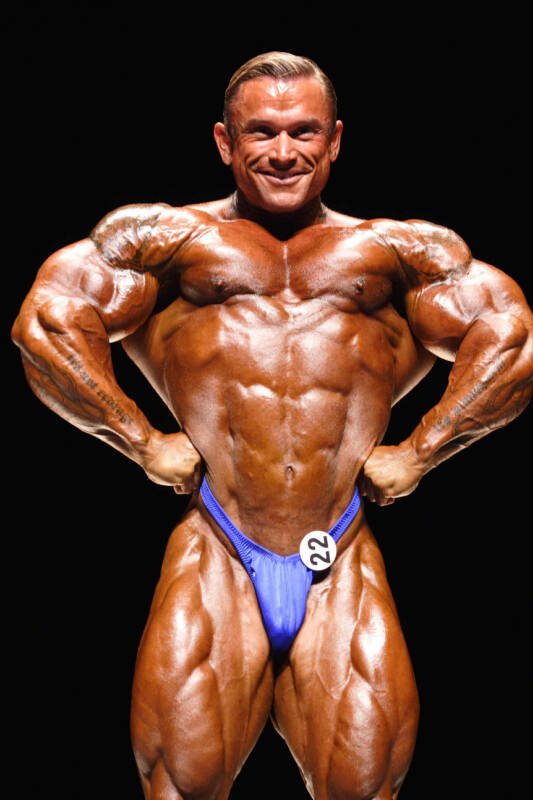
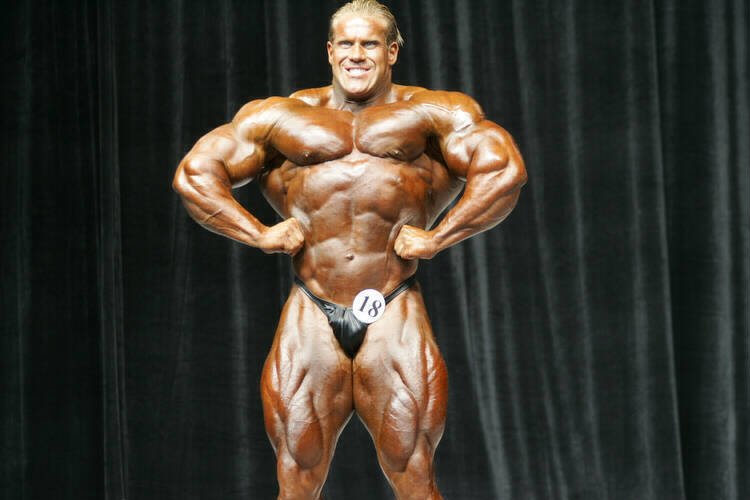
Lee Priest - 215 lbs. (left), Jay Cutler - 295 lbs. (right).
70 Pound Difference! 
Maintaining Balance

If you have skinny calves, forearms, or whatever, the number one priority should always be to hit that particular bodypart. Surprisingly, experience shows that many people does just the opposite. Keep in mind that bodybuilding - and all kind of weight training - is about maintaining balance.
A guy with a huge upper body and spider-like legs not only looks ridiculous, he has also developed an unevenness in his body that'll set him back in other areas in life (think about it - with 30 pounds more of muscle on his upper body, but with the same legs, what happens to endurance in other sports? It's like running with a 30 pound backpack!).
In this case, you would not only allow your body to get unbalanced, but also allow an already weak part of you get even weaker (as compared to the rest of you, that are hopefully gaining in strength and size). This can all be summarized in two words: Prioritized Training.
Sounds familiar? Of course - it's the same old principle as when you've let your enthusiasm for bicep-curls take precedence over tricep-training for too long. Simply put - hit your weak muscles first, and hit them hard. Then do maintenance training for the already developed muscles until your weaker muscles have caught up. Then train all muscles equally hard to make sure that you stay on the right track.

You Are The Problem, Not Genetics

If you are truly genetically "cursed", you will ALWAYS have to put in a little more effort in keeping those up to par, but frankly speaking, odds are that you will surprise yourself. More often than not, it turns out that the muscle is really Ok - it just needed your full and undivided attention.
So much for the cosmetic part of genetics. We can do a lot to tweak things our way, and even though you might never become a Mr. Olympia contestant, there's always room for improvement. In almost every case, you can improve what nature threw at you by smart, prioritized training.
This doesn't really change the basic facts - that your lats suck, that your biceps don't have that awesome peak, or that your shoulders are narrow - but you can always create an illusion of looking better than you actually do. However, there is one point where there's not that much you do and that is where your muscles attach to your bones.
You can do a lot to improve your strength - let there be no mistake about this - deadlifts, squats, and heavy bench presses are excellent ways to boost your overall core strength. However, strange as it might sound to you, a truly crucial factor is where the muscle attaches to the bones.
Think about the upper arm-bone. The pec attaches perhaps 1.5 inches away from the base of the bone, near the shoulder-joint. When you're pressing weights, you have biomechanics working against you (it's like holding a short bar with one hand at the very end!
Light as the bar might be, the mechanics makes it hard).
If you were to move your hands a couple of inches in, the bar is easier to hold. On the same coin, the longer arms you have, the heavier holding the bar will feel. Say What?
Having longer arms also means that the weight will be traveling a longer distance from top to bottom position, as opposed to someone with shorter arms. And what has to pull the extra load? The pecs. There are two factors at play: The length of your arm AND where the muscle attaches to the bone.
Assuming that the muscle is exactly as large and strong as, say on your twin, you'd still be considerably weaker if that muscle was attached only ¼ of an inch closer to shoulder joint.
Follow the logic: The muscles are equally sized and of equal strength. The muscles are working equally hard when hoisting the weight for X amount of reps. However, the small difference of where the muscle attaches, allows one of you to use 30 lbs more. Likewise, a guy with the exact same size and strength, and the exact same placement of the pec muscle attachment, will differ in strength if one of them has 20% longer arms.
Remember the bar? The guy with longer arms are holding a longer bar, making the mechanics work against him. And - not only that - the weight has to travel further than with the other guy.
This is why you rarely see any 6'8" basketball player-kind of guys in the Olympics hoisting the big weights around. Heck, some of the top guys are borderline to midgets!

Conclusion

For the sake of simplicity, I have focused mainly on simple chest presses here. But this applies to pretty much all kinds of exercises. Take squats as another example: The muscle attachments determine how "efficient" the muscles are, biomechanically, and the length of your limbs once again determine how much of a lever your own body is, and last but not least, how far you will have to lift the weight from bottom all the way up to the top.
So, to wrap it up - theres not much you can do about this. But at least you know WHY a smaller guy can lift twice as much as you in certain lifts!
Thanks,
Genetics is a popular scapegoat for lazy people. It is very convenient, and there's no one around to prove that it is, in fact, bull. It's all individually based, so when the guy who spends 2 minutes at the end of his workout every other week doing some light calf-raises, claims he has bad genetics, we can't be sure.
Perhaps he WAS born with 50% less muscle fibers in his calves than the rest of us. The most likely scenario is that he hasn't learned the basics of prioritizing, but since there's a 0.001% chance that he's right, he's pouncing on it rather than face the probable truth.
Don't Throw In The Towel
The most classic example is the guy with narrow shoulders. There isn't a bodybuilding magazine that hasn't covered this at least 10 times, so I'll keep it short:
By trimming down your waist and beefing up your deltoids, you'll create the illusion of having broad shoulders. Look at small guys like Flex Wheeler and Shawn Ray.
They're way smaller than Nasser El Sonbaty, Marcus Ruhl, and the other giants, but they still snatch the top slots!
Once again, it's all about illusions. The bottom line is that the cosmetic aspect of bodybuilding is not as dependent on genetics as many would like to think. Granted, you may have an uphill battle in some areas, but as a general rule, you can succeed.
Lee Priest - 215 lbs. (left), Jay Cutler - 295 lbs. (right).
70 Pound Difference!
Maintaining Balance
If you have skinny calves, forearms, or whatever, the number one priority should always be to hit that particular bodypart. Surprisingly, experience shows that many people does just the opposite. Keep in mind that bodybuilding - and all kind of weight training - is about maintaining balance.
| RELATED ARTICLE | ||
|
In this case, you would not only allow your body to get unbalanced, but also allow an already weak part of you get even weaker (as compared to the rest of you, that are hopefully gaining in strength and size). This can all be summarized in two words: Prioritized Training.
| RELATED POLL | |||
| |||
You Are The Problem, Not Genetics
If you are truly genetically "cursed", you will ALWAYS have to put in a little more effort in keeping those up to par, but frankly speaking, odds are that you will surprise yourself. More often than not, it turns out that the muscle is really Ok - it just needed your full and undivided attention.
So much for the cosmetic part of genetics. We can do a lot to tweak things our way, and even though you might never become a Mr. Olympia contestant, there's always room for improvement. In almost every case, you can improve what nature threw at you by smart, prioritized training.
This doesn't really change the basic facts - that your lats suck, that your biceps don't have that awesome peak, or that your shoulders are narrow - but you can always create an illusion of looking better than you actually do. However, there is one point where there's not that much you do and that is where your muscles attach to your bones.
You can do a lot to improve your strength - let there be no mistake about this - deadlifts, squats, and heavy bench presses are excellent ways to boost your overall core strength. However, strange as it might sound to you, a truly crucial factor is where the muscle attaches to the bones.
Light as the bar might be, the mechanics makes it hard).
If you were to move your hands a couple of inches in, the bar is easier to hold. On the same coin, the longer arms you have, the heavier holding the bar will feel. Say What?
Having longer arms also means that the weight will be traveling a longer distance from top to bottom position, as opposed to someone with shorter arms. And what has to pull the extra load? The pecs. There are two factors at play: The length of your arm AND where the muscle attaches to the bone.
Assuming that the muscle is exactly as large and strong as, say on your twin, you'd still be considerably weaker if that muscle was attached only ¼ of an inch closer to shoulder joint.
Follow the logic: The muscles are equally sized and of equal strength. The muscles are working equally hard when hoisting the weight for X amount of reps. However, the small difference of where the muscle attaches, allows one of you to use 30 lbs more. Likewise, a guy with the exact same size and strength, and the exact same placement of the pec muscle attachment, will differ in strength if one of them has 20% longer arms.
Remember the bar? The guy with longer arms are holding a longer bar, making the mechanics work against him. And - not only that - the weight has to travel further than with the other guy.
This is why you rarely see any 6'8" basketball player-kind of guys in the Olympics hoisting the big weights around. Heck, some of the top guys are borderline to midgets!
Conclusion
For the sake of simplicity, I have focused mainly on simple chest presses here. But this applies to pretty much all kinds of exercises. Take squats as another example: The muscle attachments determine how "efficient" the muscles are, biomechanically, and the length of your limbs once again determine how much of a lever your own body is, and last but not least, how far you will have to lift the weight from bottom all the way up to the top.
So, to wrap it up - theres not much you can do about this. But at least you know WHY a smaller guy can lift twice as much as you in certain lifts!
Thanks,
Thursday, May 6, 2010
Microwaved Foods
Dangerous Facts About Microwave Oven
| Important. Take care of your health. (Note - The following link is from Ms. Nenah Sylver and found it of such importance that we are posting it hoping that the author will contact us so we can give full attribution. "Below is a science fair project that my granddaughter did for 2006. In it she took filtered water and divided it into two parts. The first part she heated to boiling in a pan on the stove, and the second part she heated to boiling in a microwave. Then after cooling she used the water to water two identical plants to see if there would be any difference in the growth between the normal boiled water and the water boiled in a microwave. She was thinking that the structure or energy of the water may be compromised by microwave. As it turned out, even she was amazed at the difference.") I have known for years that the problem with micro waved anything is not the radiation people used to worry about, It's how it corrupts the DNA in the food so the body can not recognize it. So the body wraps it in fat cells to protect itself from the dead food or it eliminates it fast. Think of all the Mothers heating up milk in these "Safe" appliances. What about the nurse in Canada that warmed up blood for a transfusion patient and accidentally killed them when the blood went in dead. But the makers say it's safe. But proof is in the pictures of living plants dying. Five Reasons to Throw out your Microwave Oven From the conclusions of the Swiss, Russian and German scientific clinical studies, we can no longer ignore the microwave oven sitting in our kitchens. Based on this research, we will conclude this article with the following: !). The human body cannot metabolize [break down] the unknown by-products created in micro waved food. 2). Minerals, vitamins, and nutrients of all micro waved food is reduced or altered so that the human body gets little or no benefit, or the human body absorbs altered compounds that cannot be broken down. 3). The minerals in vegetables are altered into cancerous free radicals when cooked in microwave ovens. 4). Microwaved foods cause stomach and intestinal cancerous growths [tumors]. This may explain the rapidly increased rate of colon cancer in America. 5). Eating microwaved food causes loss of memory, concentration, emotional instability, and a decrease of intelligence. |
How to stop cough in 5 minutes!!!
This is a must try....
We have all been kept awake by our own or someone else's cough. Try this and pass it on. The tip and not the cough. ANYTHING is better than antibiotics. Even babies could benefit from this and the parents wouldn't worry about the safety of their child. And of course, it is harmless and free from any type of side-effects.
Treatment:
To stop night time coughing in a child (or an adult, as we found out personally), put Vicks Vapor Rub generously on the bottom of the feet at bedtime and then cover with socks.
Even persistent, heavy, deep coughing will stop in about five minutes and stay stopped for many, many hours of relief. This works 100 percent of the time, and is more effective in children than even very strong prescription cough medicines. In addition it is extremely soothing and comforting and they will sleep soundly…
Tuesday, April 13, 2010
Five fitness principles
March 23rd, 2010
Five fitness principles
1.Keep your metabolism fired up. If you want to take full advantage of this standard, then you have to concentrate on morning exercise program. By doing this you will burn more calories from fat in the morning (on an empty stomach), and you will get a greater metabolic increase than if you exercise at night.
2. Don’t eat too much at night try to avoid eating late night food. Eat 4 hours before you go to bed.
3. Drink maximum water. Water is essential to mobilizing and burning fat. Keep a 20-ounce water bottle by your desk, in your car and by your bedside and try to drink eight glass of water a day.
4. You have to keep a record of your daily caloric consumption as you fine-tune your program according to your goals.
5. Allow yourself some of the foods you love – in moderation. It will keep you normal and increase your commitment to the entire program over the long haul.
The 10 Essential Nutritional Tips For Getting Lean
1.Eliminate junk foods. (Fats and Sugars).
2. Reduce the amount of overall fat in your diet to maximum of 30%. Eating less than 20% of your calories from fat is even better. But remember, some fat is essential and some fats are better than others.Olives, nuts and seeds, various oils – and canola.Fatty fish are all good fat choices. Keep some of these types of fats in your diet.
3. Adjust your caloric ratio to increase protein during the day and decrease carbs at night. As a general rule, you want about a gram of protein per pound of body weight per day. Eat protein throughout the day so your muscles get what they need, when they need it. Keep carbs lower in the evening, as you have fewer energy demands as the day goes on.
4. As the saying goes: Eat breakfast like a king, lunch like a prince and dinner like a pauper.
5. Time your carbs. Get your carbs in the morning and afternoon and lay off them at night when your body does not burn them as efficiently. Carbs are also best when eaten before or after workout.
6. Eat several small meals (5-6 per day), and eat less as the day goes on.
7. Eat 25-35 grams of fiber a day. Great sources of fiber include wheat bran, oatmeal and beans.
8. Vegetables are a great snack and a great mainstay. Eat five servings of veggies a day.
9. Eat and do brisk walk. Very light physical activity, like a stroll after dinner, not only helps digestion, but also helps boost the metabolism.
10. Take supplement’s in your diet with nutrients in needs – especially if you are cutting calories.
1.Eliminate junk foods. (Fats and Sugars).
2. Reduce the amount of overall fat in your diet to maximum of 30%. Eating less than 20% of your calories from fat is even better. But remember, some fat is essential and some fats are better than others.Olives, nuts and seeds, various oils – and canola.Fatty fish are all good fat choices. Keep some of these types of fats in your diet.
3. Adjust your caloric ratio to increase protein during the day and decrease carbs at night. As a general rule, you want about a gram of protein per pound of body weight per day. Eat protein throughout the day so your muscles get what they need, when they need it. Keep carbs lower in the evening, as you have fewer energy demands as the day goes on.
4. As the saying goes: Eat breakfast like a king, lunch like a prince and dinner like a pauper.
5. Time your carbs. Get your carbs in the morning and afternoon and lay off them at night when your body does not burn them as efficiently. Carbs are also best when eaten before or after workout.
6. Eat several small meals (5-6 per day), and eat less as the day goes on.
7. Eat 25-35 grams of fiber a day. Great sources of fiber include wheat bran, oatmeal and beans.
8. Vegetables are a great snack and a great mainstay. Eat five servings of veggies a day.
9. Eat and do brisk walk. Very light physical activity, like a stroll after dinner, not only helps digestion, but also helps boost the metabolism.
10. Take supplement’s in your diet with nutrients in needs – especially if you are cutting calories.
Subscribe to:
Posts (Atom)